Airport robots can move bags, clean floors, guide passengers, and inspect spaces after hours. Their value depends on the task, the airport layout, and what happens when a sensor or network connection fails.
- Robots suit repeatable jobs in busy public areas.
- LiDAR and cameras help them detect people, walls, vehicles, and bags.
- Human staff still need control of unusual or safety-sensitive events.
Where airport robots help
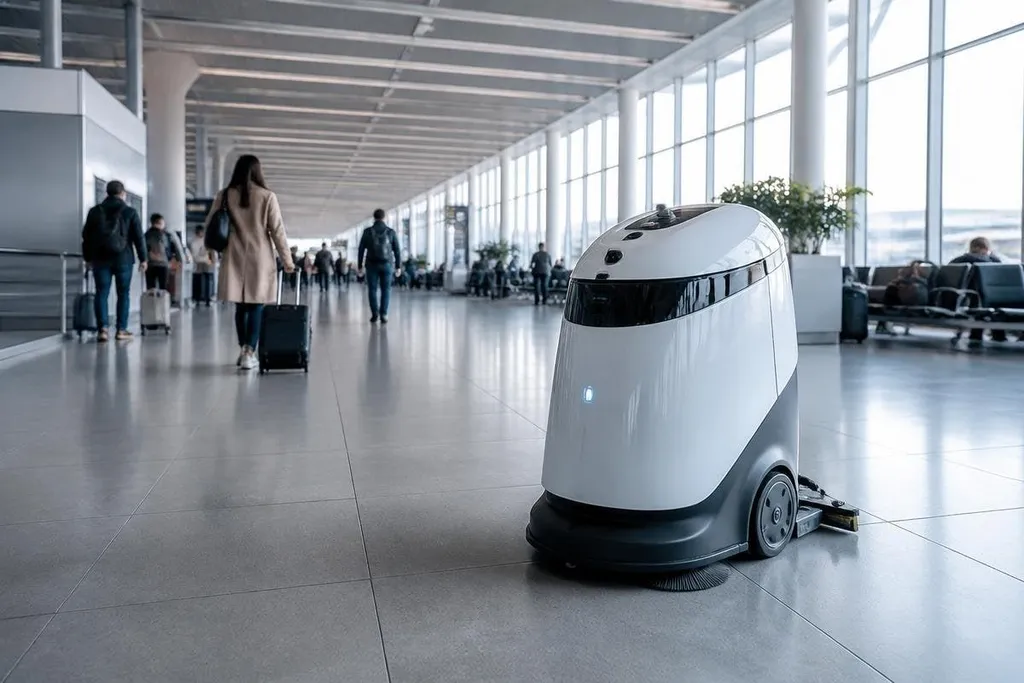
Cleaning is a clear fit because the work follows repeatable routes. A mobile cleaning robot can use maps, LiDAR, and cameras to move around gates, corridors, and open floors while staff handle spills, crowds, and blocked paths.
Baggage work offers another possible use. Baggage robots can carry bags or equipment across a terminal, reducing the amount of walking required from airport staff. That only helps if the robot can share lanes with carts, passengers, wheelchairs, and service vehicles without slowing the whole operation.
Passenger guidance needs a different design. A screen, speaker, and map can help someone find a gate or baggage claim, but the robot must know when to hand the conversation to a person. A lost passenger may need an answer based on a delay, a closed corridor, or a missed connection rather than a fixed route.
Inspection robots can also check areas that are empty or hard to reach. Cameras can record images for a staff member to review, while sensors can report temperature, air quality, or an open door. The system still needs a clear process for checking and acting on those reports.
The risks start with shared space
An airport is a poor place for a robot that works well only in a clean test area. People stop without warning, luggage can sit in a travel path, and a service cart can block the route shown on the robot's map.
The robot needs obstacle detection that can spot more than walls. LiDAR measures distance with laser light, while cameras help identify objects and people. Neither system removes the need for safe speed limits, emergency stops, marked operating areas, and staff who can take control.
Cybersecurity creates another risk. A connected robot may receive maps, task orders, software updates, and remote commands through an airport network. Access should use strong identity checks, limited permissions, and logs that show who changed a setting or sent a command.
Privacy also needs a plain rule. Cameras that help a robot move may record passengers, staff, or children. Airport operators need to state what the system records, how long it keeps the data, and who can view it. A sign alone doesn't fix poor access control.
What the business case must show
The purchase price is only one part of the cost. The airport also needs charging equipment, network access, software support, spare parts, staff training, safety checks, and a plan for faults.
The useful measure is the task result. Does the robot cut walking time for baggage staff? Does cleaning cover the same area with fewer manual passes? Does passenger guidance reduce calls at an information desk? Each answer needs a local trial with records that staff can check.
Airport teams need evidence from full shifts, blocked routes, and staff handoffs. Airport robotics coverage from Robot24.com can connect those details to a named machine and trial site, giving buyers a firmer basis than a polished demo.
A public demo may show movement; an airport needs proof that the system works through a full shift and recovers from blocked routes.
No single robot fits every terminal. A small indoor unit may work near gates, while baggage movement may need a larger platform with a different safety design. The airport should match the robot to one task before adding more work.
A buying checklist for airport teams
Use these checks before moving from a demo to a live trial:
- Name one task: Set a clear job, route, start point, and finish point.
- Record failure handling: Check what happens after a blocked path, lost map, low battery, or network drop.
- Set human control: Give named staff a fast way to stop, pause, or redirect the robot.
- Check data access: List every camera feed, stored image, user account, and remote connection.
- Measure the work: Record task time, staff hours, stops, faults, and passenger complaints.
- Price the full setup: Include charging, software, training, repairs, and extra safety equipment.
I'd approve airport robots only when the operator can show the task result and the failure plan in the same trial. A unit that moves well in a quiet terminal is easy to demonstrate; the useful test begins when the route is blocked, the crowd grows, or a person needs help.
The next decision is small and measurable: choose one route, one task, and one named team to supervise it.